

Every Shortcut Ends Up in the Jar
Real shilajit begins in the mountains. What happens next determines whether you are buying a documented resin or another dark jar asking for blind trust.

Shilajit stories usually open on a Himalayan ridge.
That makes sense. Shilajit is a dark, mineral-rich natural resin associated with high mountain environments. It has a long history in Ayurveda, where it has traditionally been used to support vitality and energy.
But a dramatic landscape can do too much work in an advert.
The mountain tells you where the raw material is said to begin. It does not tell you how that material was handled, how the finished resin was assessed or what is actually in the jar.
Raw shilajit is not the finished supplement. Between collection and your morning mug come decisions about selection, purification, concentration, drying, testing and packaging. A shortcut at any one of those points can become an unanswered question for the buyer.
That is why our origin story does not stop at altitude. We want you to follow the whole chain.
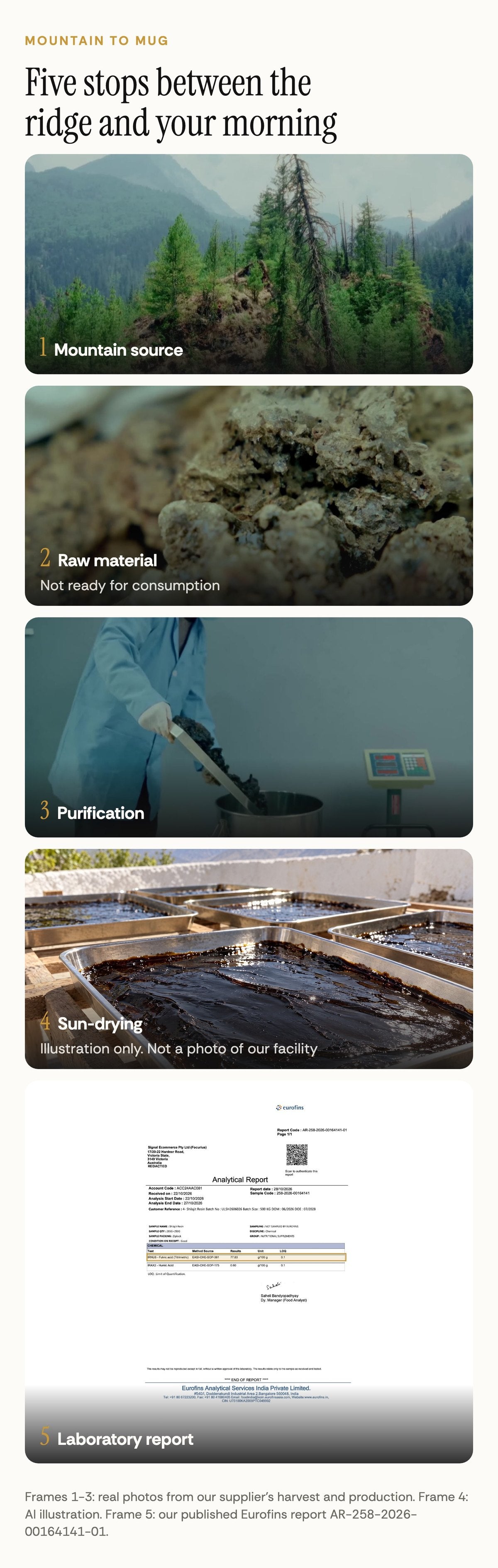
Sourced above 17,000 feet
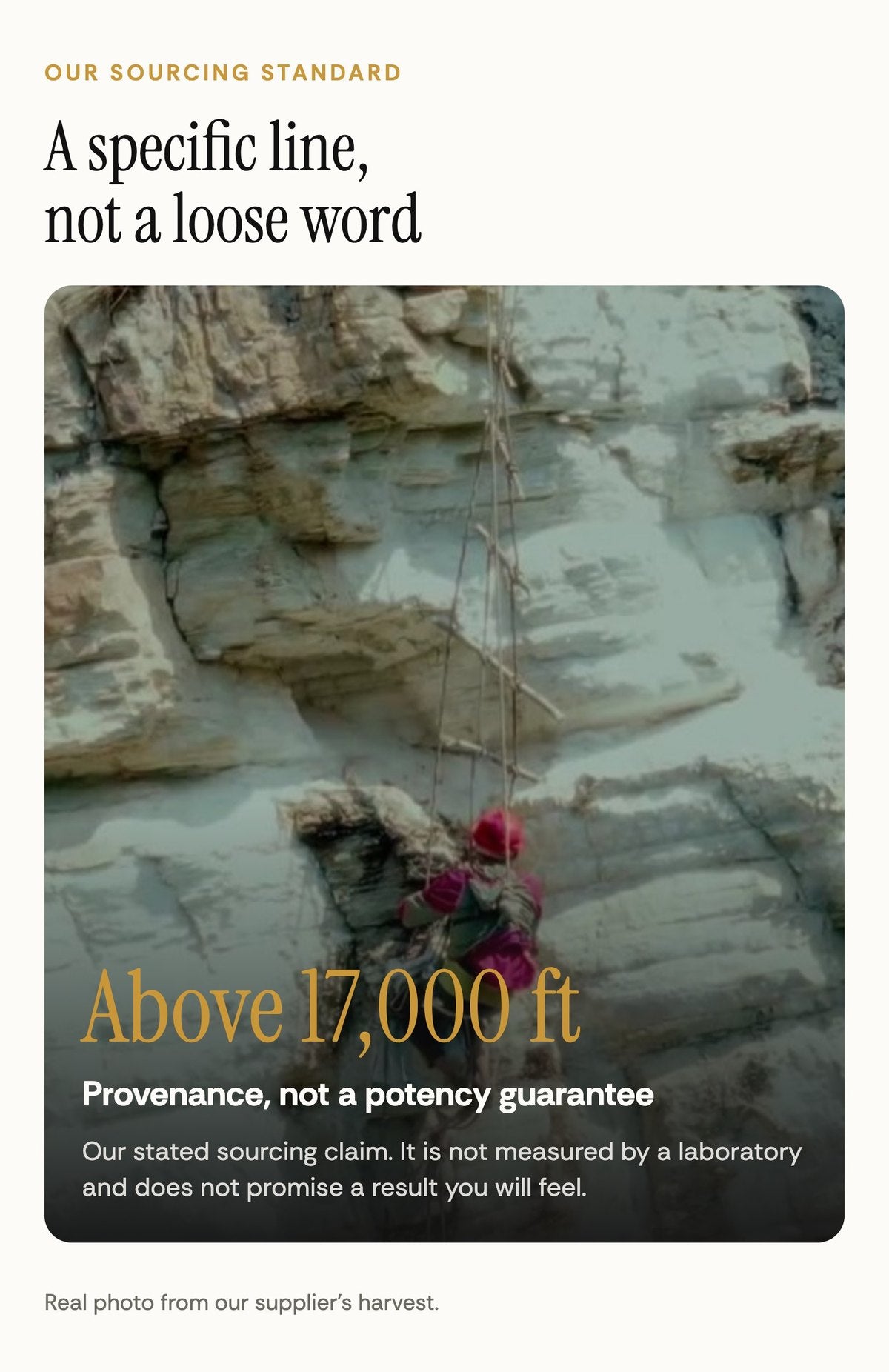
We state that Black Gold is harvested above 17,000 feet in the Himalayas.
We do not ask that number to prove more than it can. Altitude does not independently prove purity, potency or a result you will feel. A mountain claim is not a laboratory result.
What it gives you is a specific sourcing standard instead of a loose word such as “Himalayan”. It tells our supply chain where we are willing to begin, and it gives you a claim you can ask us to substantiate.
That distinction matters. Vague origin language creates romance. A specific, documented origin creates accountability.
For the reader, the benefit is not that 17,000 feet guarantees a superhuman morning. The benefit is knowing that we have drawn a line around provenance before the processing even starts.
Purified in three deliberate stages
Mountain origin is not permission to skip refinement.
Raw natural material can contain grit and other unwanted matter. That is why the journey from collected material to a finished supplement needs a defined purification process.
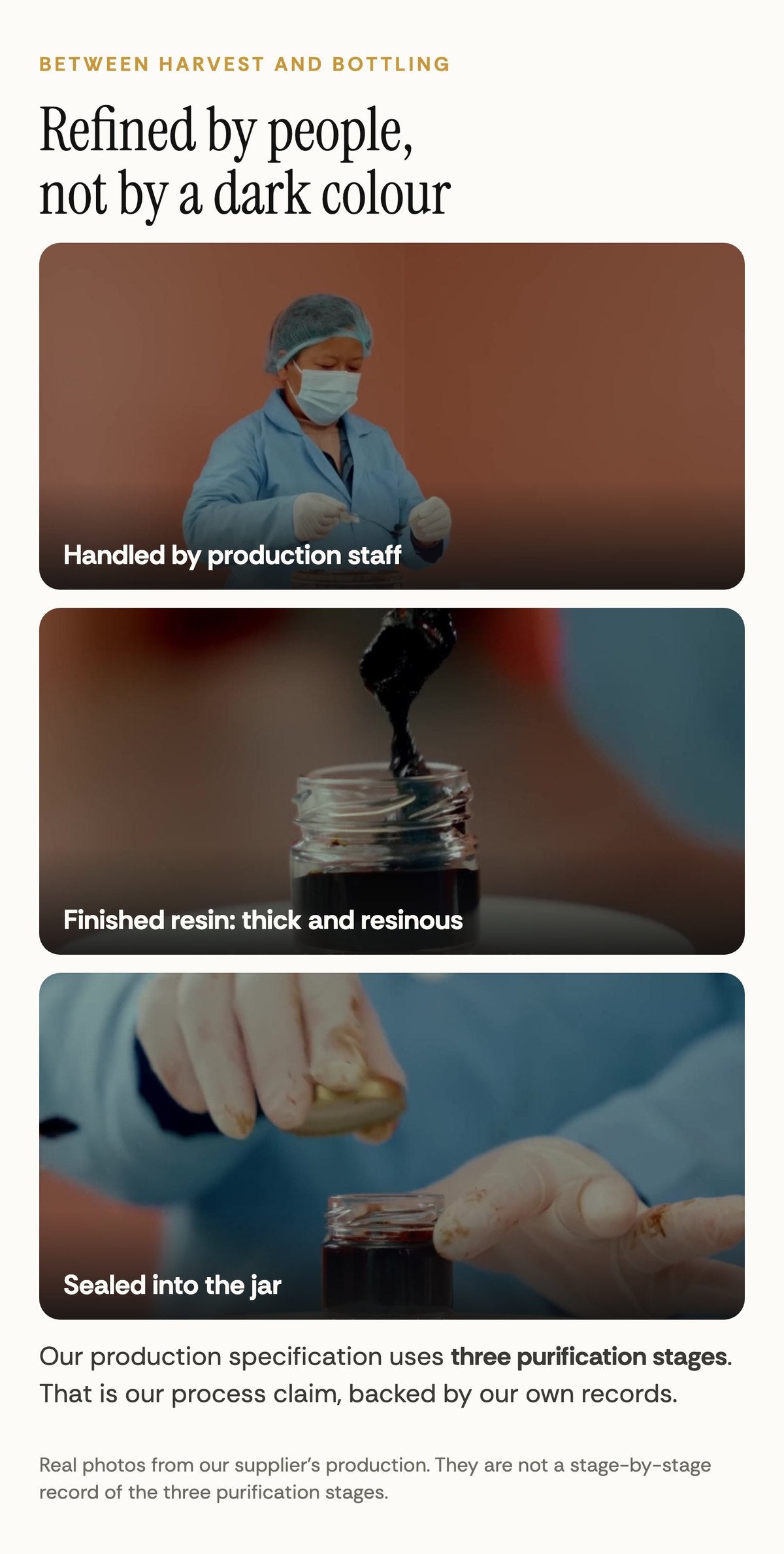
Our production specification uses three purification stages. The purpose of stating that process is not to make “three” sound mystical. It is to show that we do not treat one pass and a dark colour as enough.
For you, that means the jar comes with an answer to a basic buying question: what happened between harvest and bottling?
It also means our process can be checked against a repeatable internal standard. That does not make every jar identical to a laboratory instrument's last decimal place, because shilajit is a natural material. It does mean we have a defined method to follow rather than improvising from one batch to the next.
The finished texture should be resinous. The taste should be earthy, mineral and slightly bitter. The serving should dissolve into a warm drink. Those practical qualities matter more at breakfast than a poetic origin story ever will.
Sun-dried over 40 days
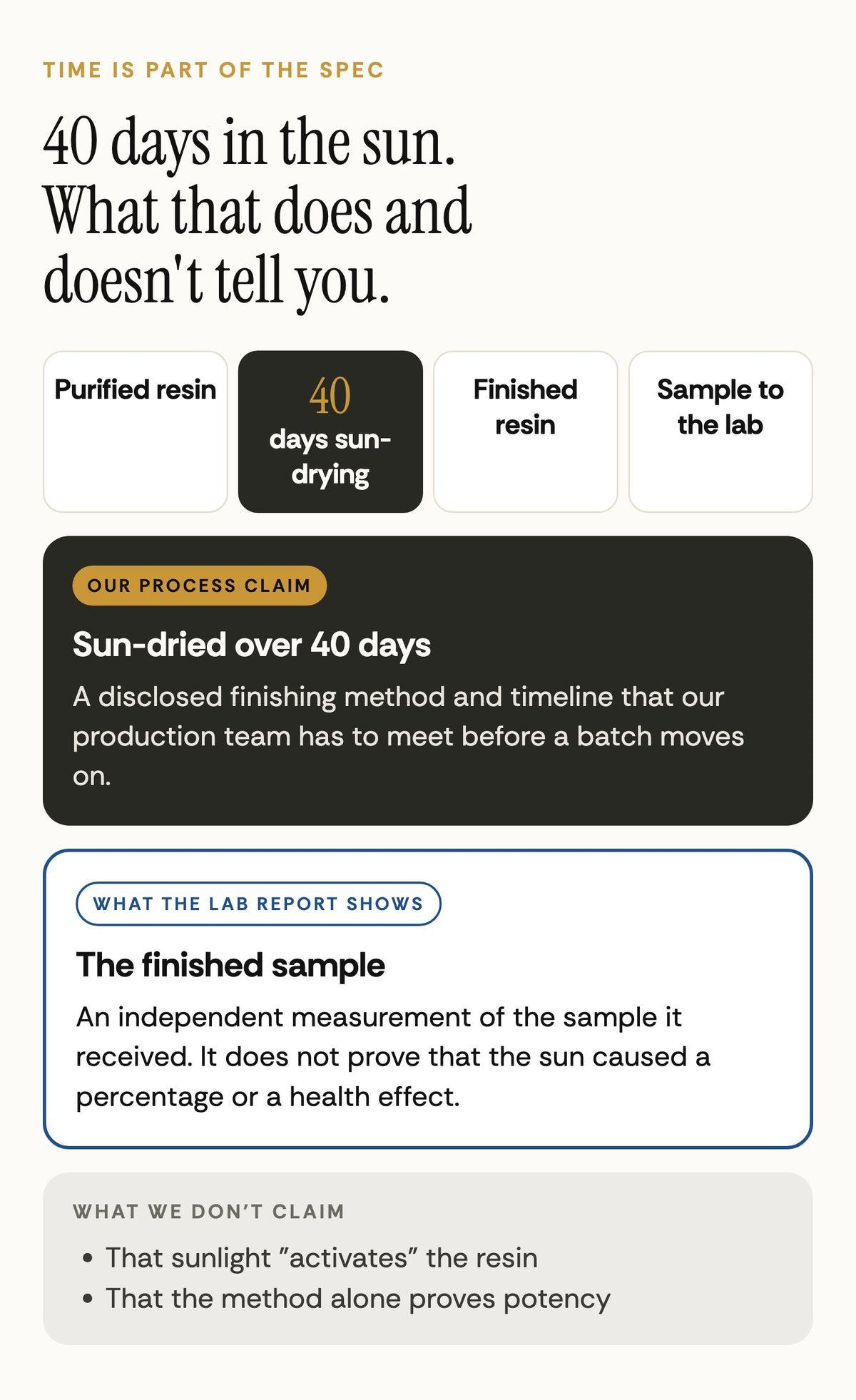
After purification, we sun-dry our resin over 40 days.
We could turn that into a fantasy about sunlight “activating” the resin. We will not. The independent report measures the finished sample. It does not prove that the sun caused a particular percentage, protected a specific compound or created a health effect.
The honest benefit of our 40-day method is simpler: you know how we choose to concentrate and finish the resin, and you know we are willing to allow time for that process.
That matters in a category full of labels that reveal almost nothing between “mountain” and “jar”. A disclosed drying method gives you another point of comparison. It also gives us a standard our production team has to meet before a batch reaches the next step.
No shortcut here means no vague “processed for purity” line. We name the method and the time because a premium product should explain why it takes longer to make.
The report matters more than the scenery
Origin, purification and drying are our process claims. Laboratory reports answer a different question: what did an independent laboratory measure in the sample it received?
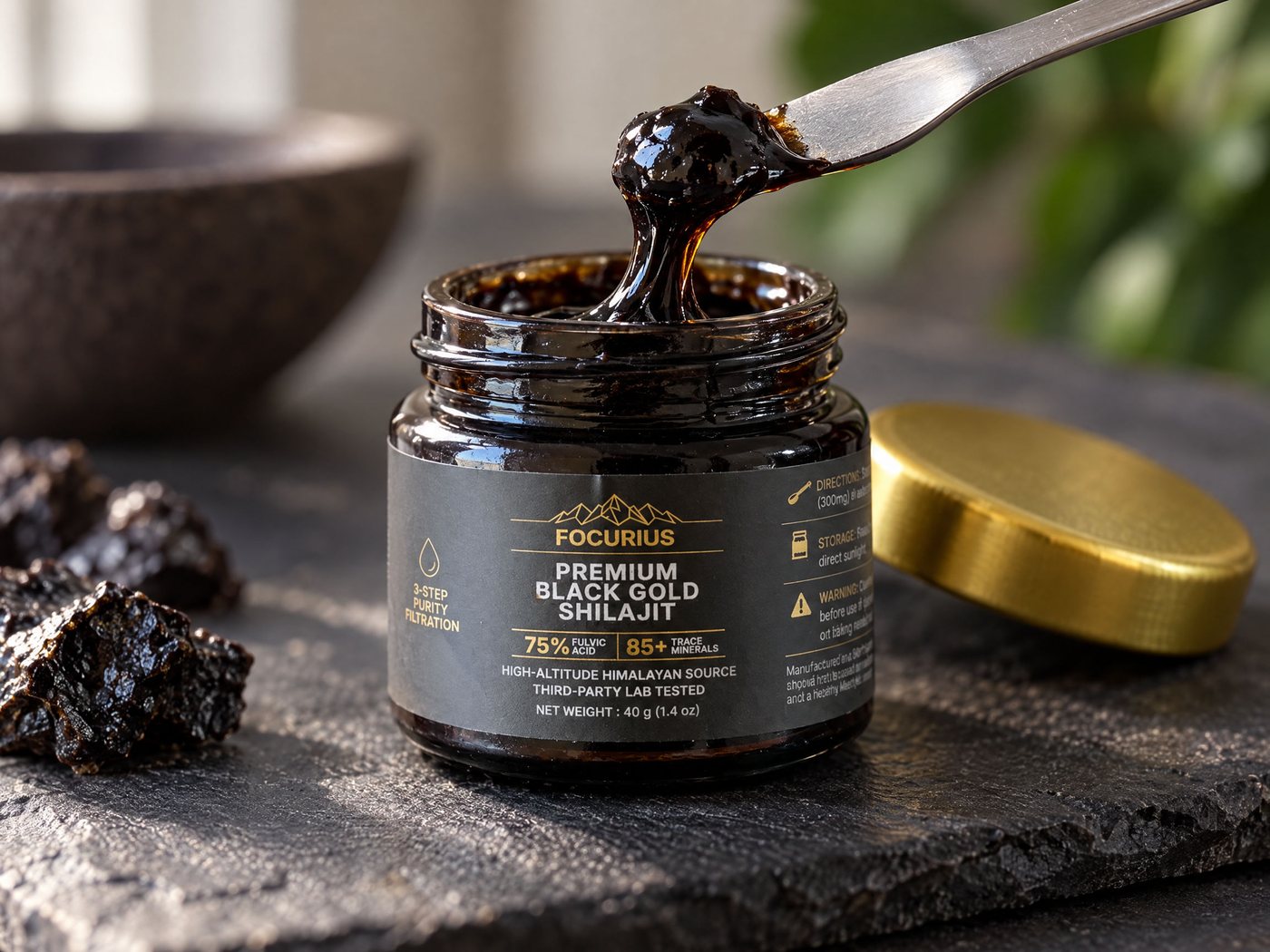
Our label states 75% fulvic acid. In Eurofins report AR-258-2026-00164141-01, issued 28 October 2026, the tested sample measured 77.83 g/100 g fulvic acid. We do not round that result into a promise about every future jar. We publish it as the result for that submitted sample.
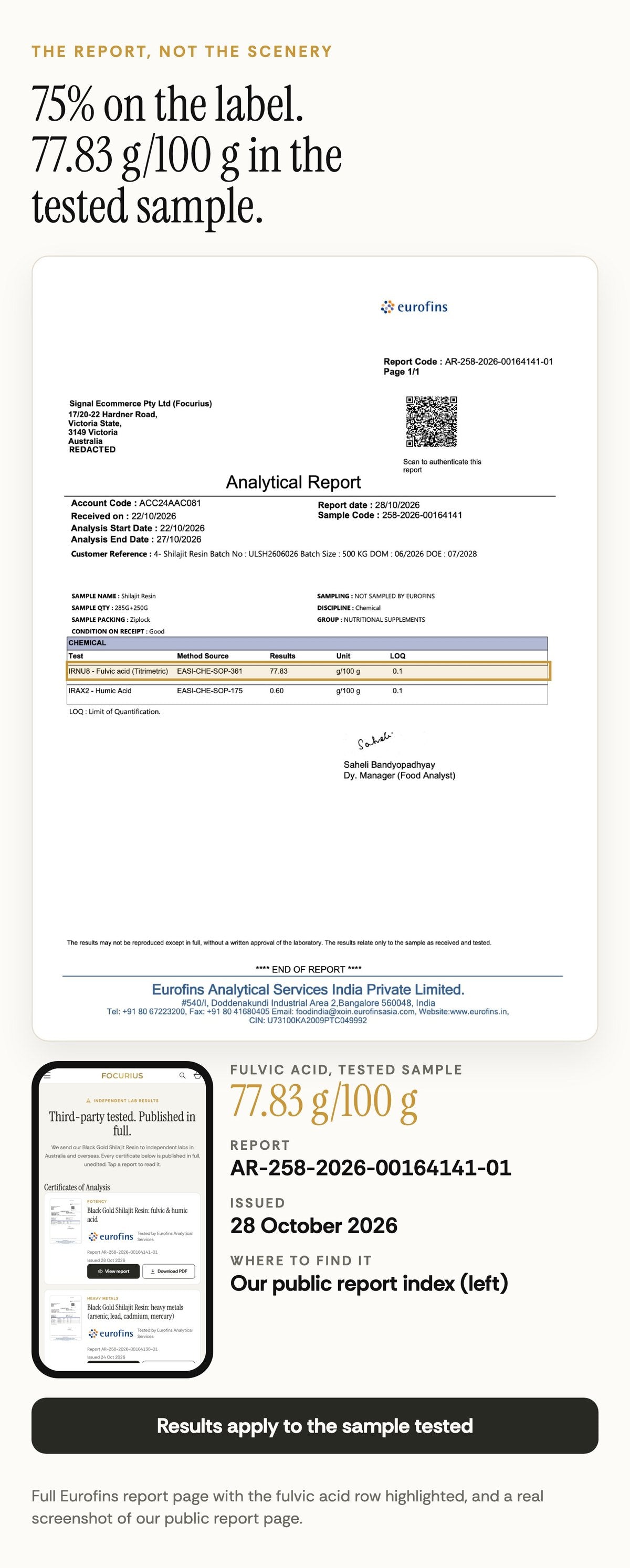
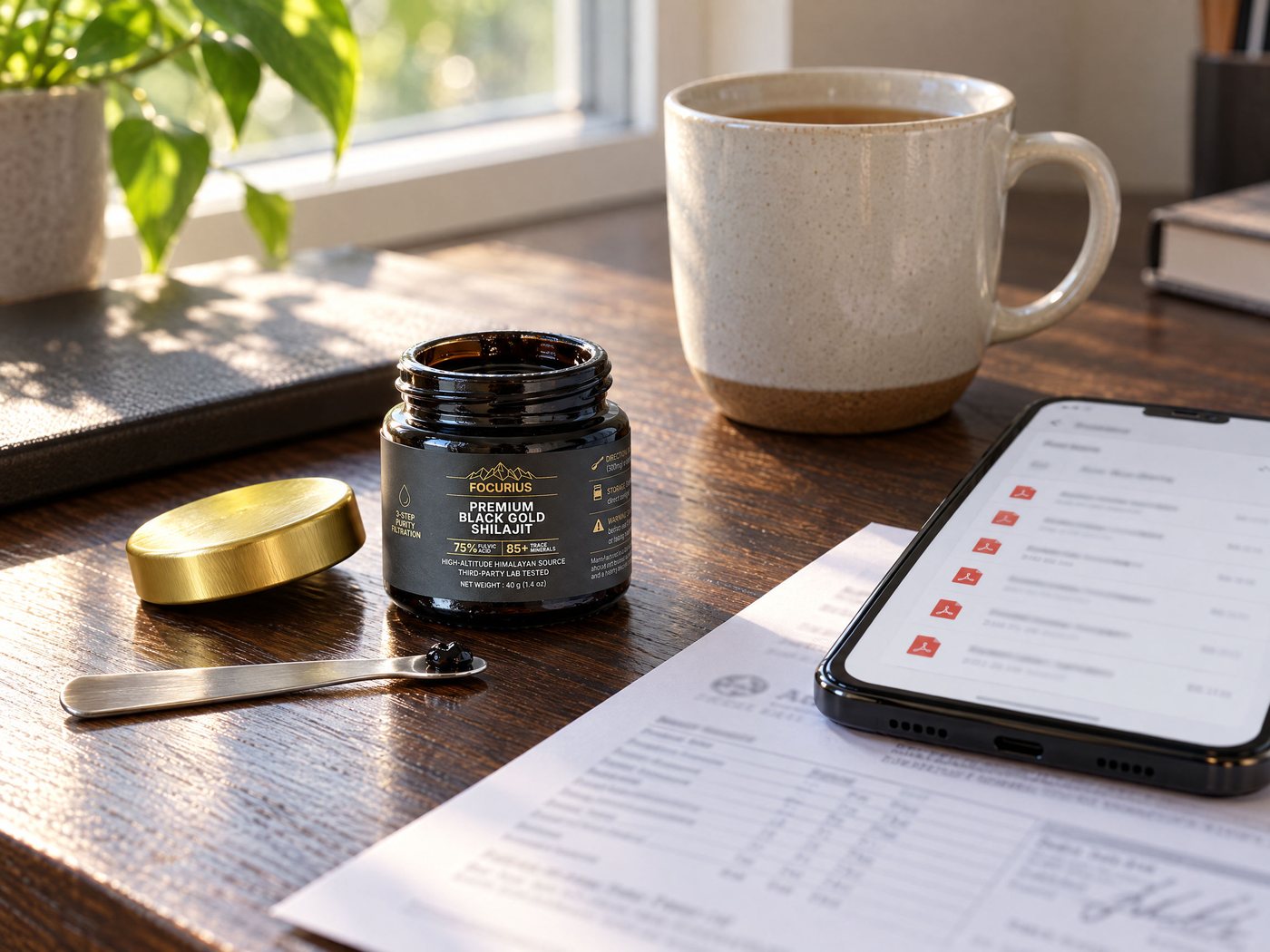
Our public report page currently contains eight reports. They cover areas including fulvic and humic acid, minerals, moisture and water activity, pesticides, mycotoxins, PAHs and heavy metals.
The current Eurofins heavy-metals report tests arsenic, cadmium, lead and mercury in the submitted sample. The correct statement is “tested for heavy metals”. It is not “heavy-metal free”. Precision is not weaker marketing. It is more useful information.
A separate Eurofins mineral panel identifies magnesium, potassium, iron, zinc, copper, manganese, sodium and boron in the tested sample. Our label states 85+ ionic minerals, but that eight-mineral panel does not independently enumerate all 85+.
We show you those limits because transparency should include what a document does not prove.
The point of all this is not to make the process sound difficult. It is to make the purchase easier to judge.
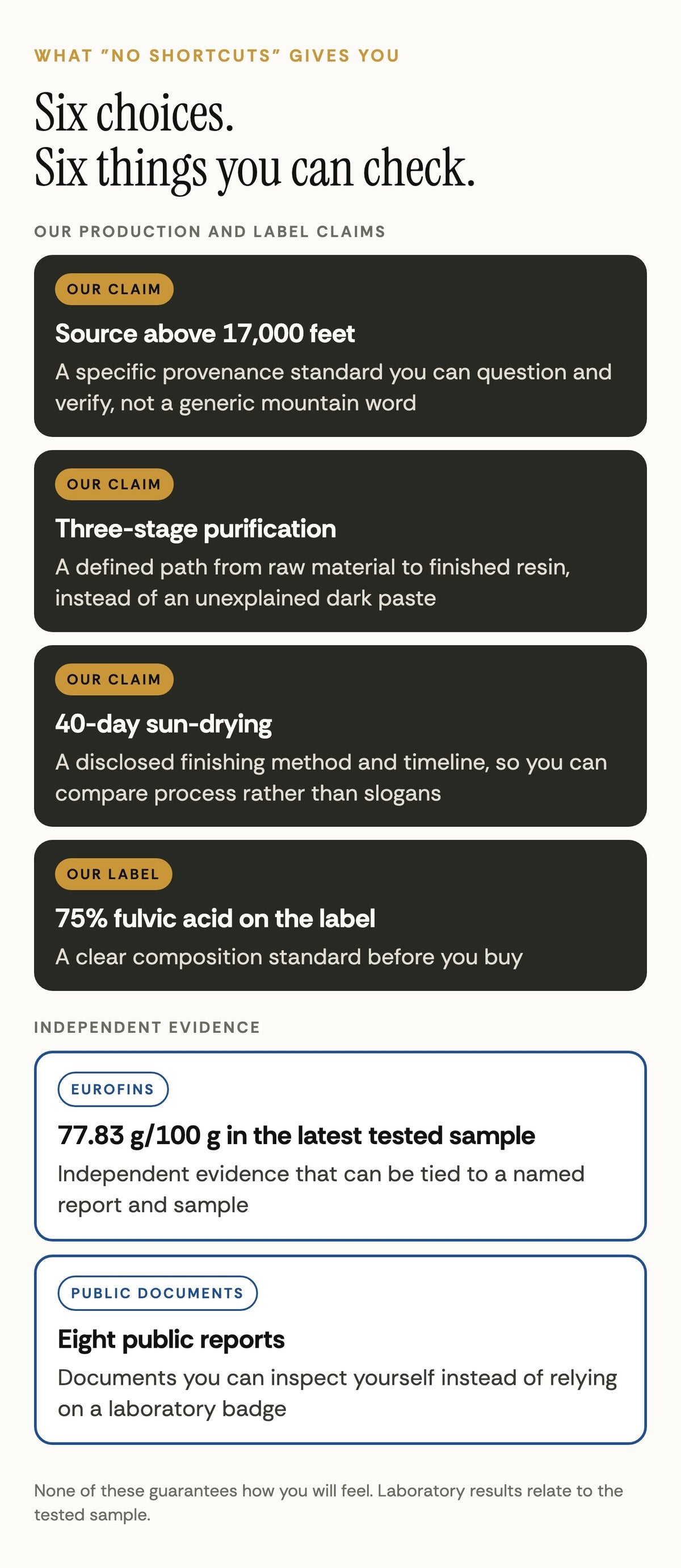
None of those rows guarantees how you will feel. Together, they reduce the number of things you are being asked to take on faith.
That is the reader benefit of refusing shortcuts: more of the chain is visible. You can see where our claims end, where independent measurement begins and which questions still deserve an honest answer.
After all that sourcing, purification, drying and testing, using Black Gold is deliberately simple.
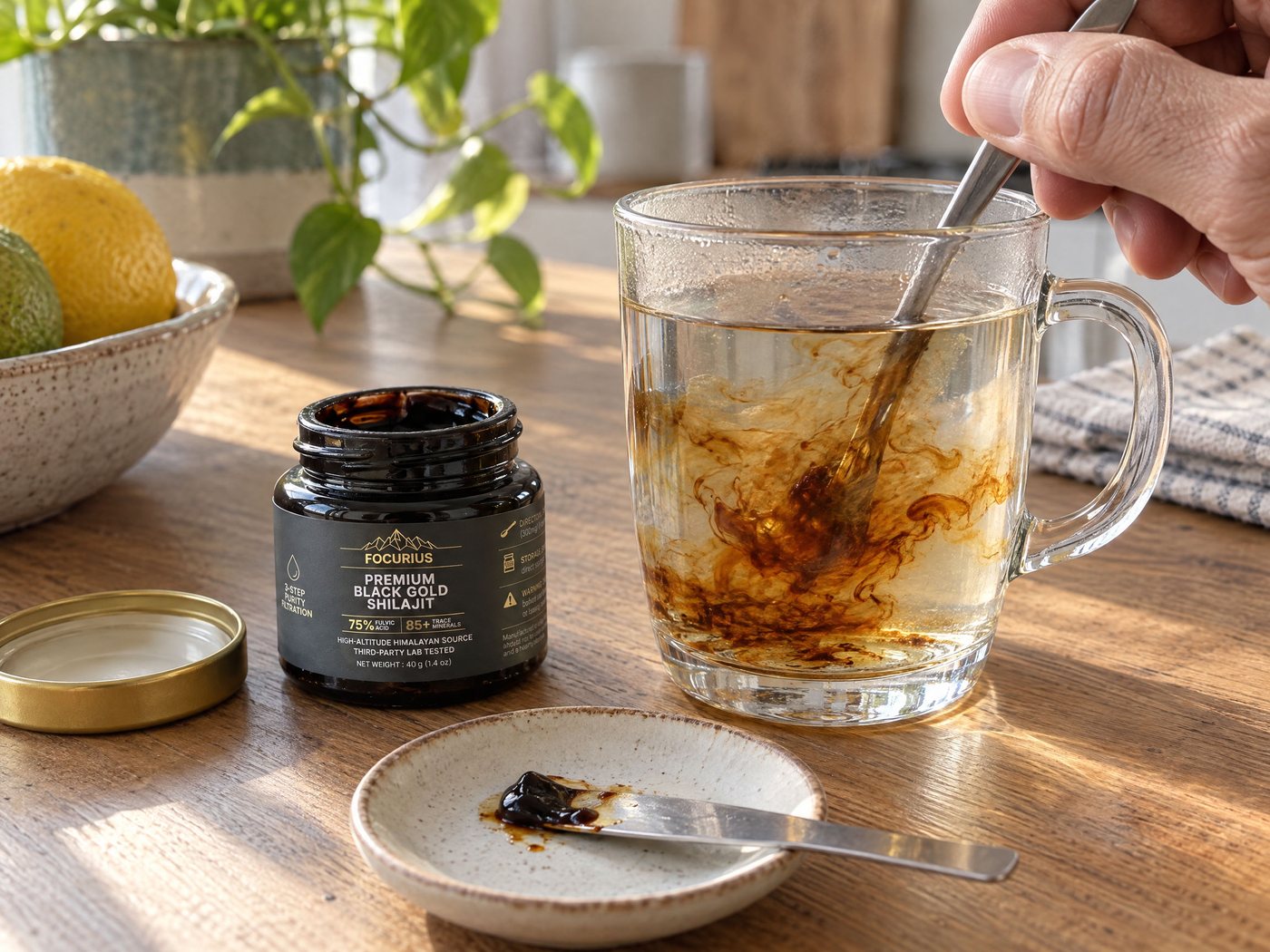
Take 300 to 500 mg, roughly a rice-grain to pea-sized amount, and dissolve it in warm water, tea or coffee. Most people place it in a morning routine. Follow the directions on the current label.
The taste is earthy, mineral and slightly bitter. That is worth saying before your first mug. This is resin, not confectionery.
Shilajit has traditionally been used in Ayurveda to support vitality and energy. That history explains why people consider it. It does not guarantee a result, and it does not make our process a treatment for tiredness or any health condition.
Judge the ritual fairly. Keep the rest of your routine reasonably steady. Notice whether it earns a place in your morning. Do not borrow a dramatic timeline from an advert or someone else's review.
Our work is to make a resin whose source, method and tested composition you can inspect. Your work is simply to decide whether it suits you.
Pay for the visible process, not the mountain story
Black Gold is currently A$109 for one jar. Buy 2 Get 1 Free is A$218, and Buy 3 Get 2 Free is A$327.
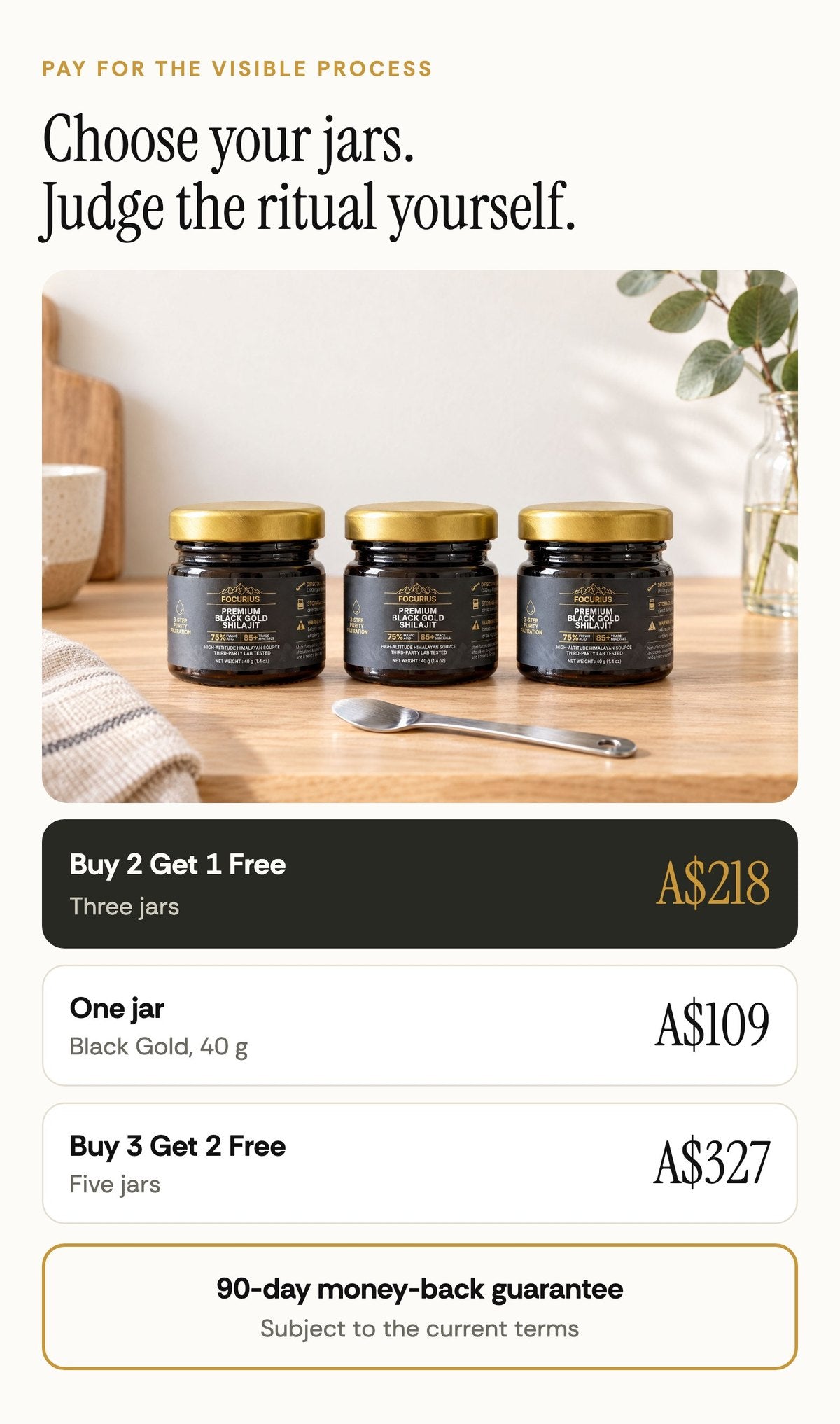
Every order is backed by our 90-day money-back guarantee, subject to the current terms. If the ritual does not earn its place, use the guarantee.
Does high altitude prove that a jar is pure?
No. Our altitude statement is a sourcing claim. Purification records and sample-specific laboratory reports provide different forms of evidence.
Does the laboratory verify the three-stage process or 40-day drying time?
No. Those are our production claims and need our own process records. The laboratory reports show measurements for the submitted samples.
Why not use a cheaper, faster drying method?
We chose a 40-day sun-drying standard because we want a disclosed, patient finishing process. We do not claim the method alone proves potency or creates a specific health effect.
Can I inspect the reports before buying?
Yes. Our public report page lists eight current reports, including the fulvic and humic acid report and heavy-metals panel. Recheck the report index for the batch available when you purchase.
Is Black Gold suitable for everyone?
The mountain makes a beautiful opening. We believe the method and the evidence should finish the story.
Always read the label and follow the directions for use. Consult your healthcare professional if you are pregnant, breastfeeding or taking medication.