

5 Reasons Your Shilajit Might Be Fake
The jar looks right. The label sounds ancient. These five missing details tell you whether there is real substance behind the story.
You bought the black jar, tolerated the earthy taste and waited for the miracle from the ad. Then nothing felt clear except the money leaving your account.
Before deciding the entire category is rubbish, audit the jar. Colour, stickiness and a Himalayan picture can be copied. Concentration, provenance, process records and an independent report take more work.
These five warning signs do not prove that an unnamed product is counterfeit. They tell you when a seller has left too much hidden for an informed decision.
The Fulvic Percentage Is Missing
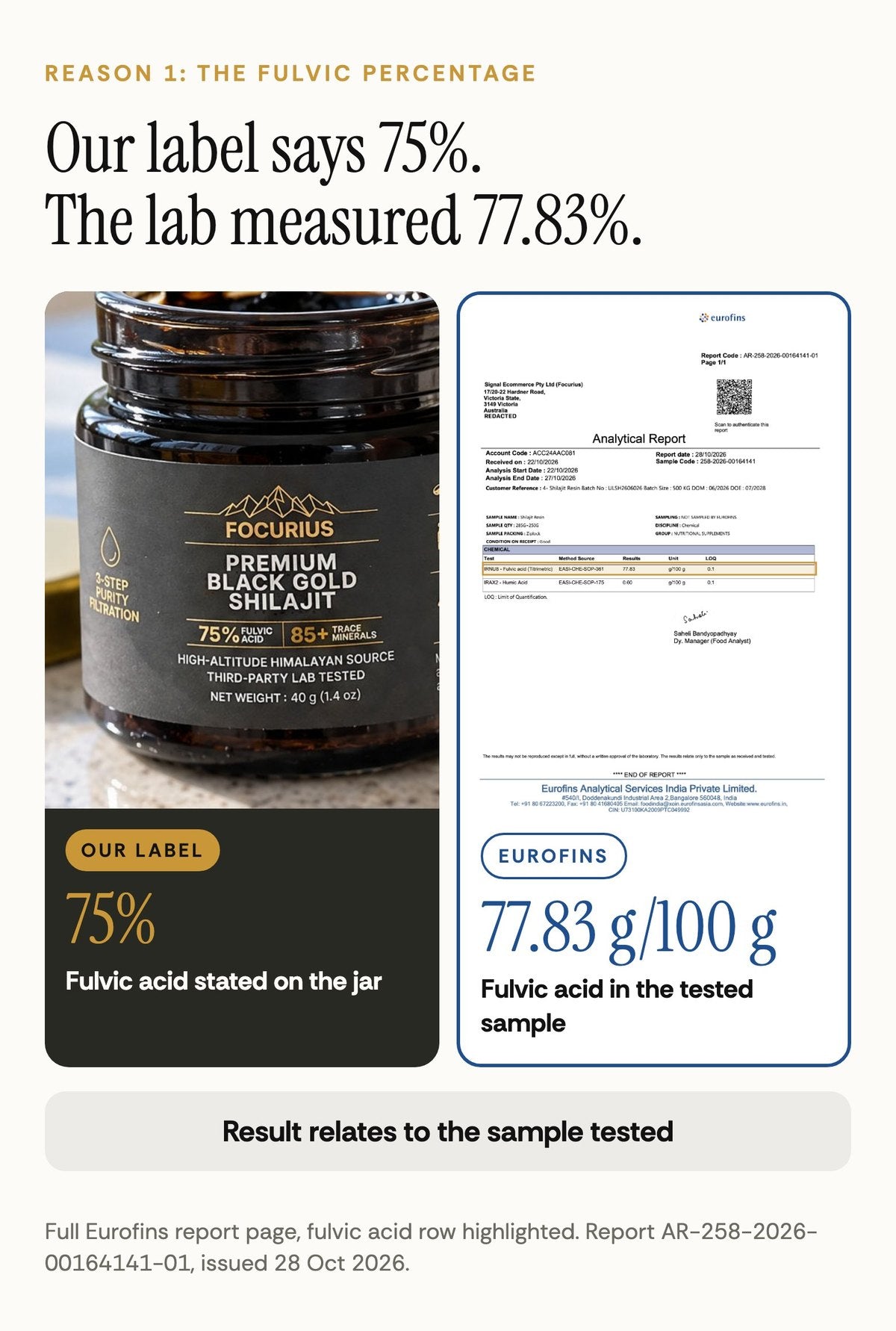
Fulvic acid is one measurable component of finished shilajit. Yet some labels leave the percentage unstated, bury it in vague “high potency” language or show a figure with no report behind it. Even a label around 30% is not automatic proof of a fake. It is simply a different concentration from a resin labelled at 75%.
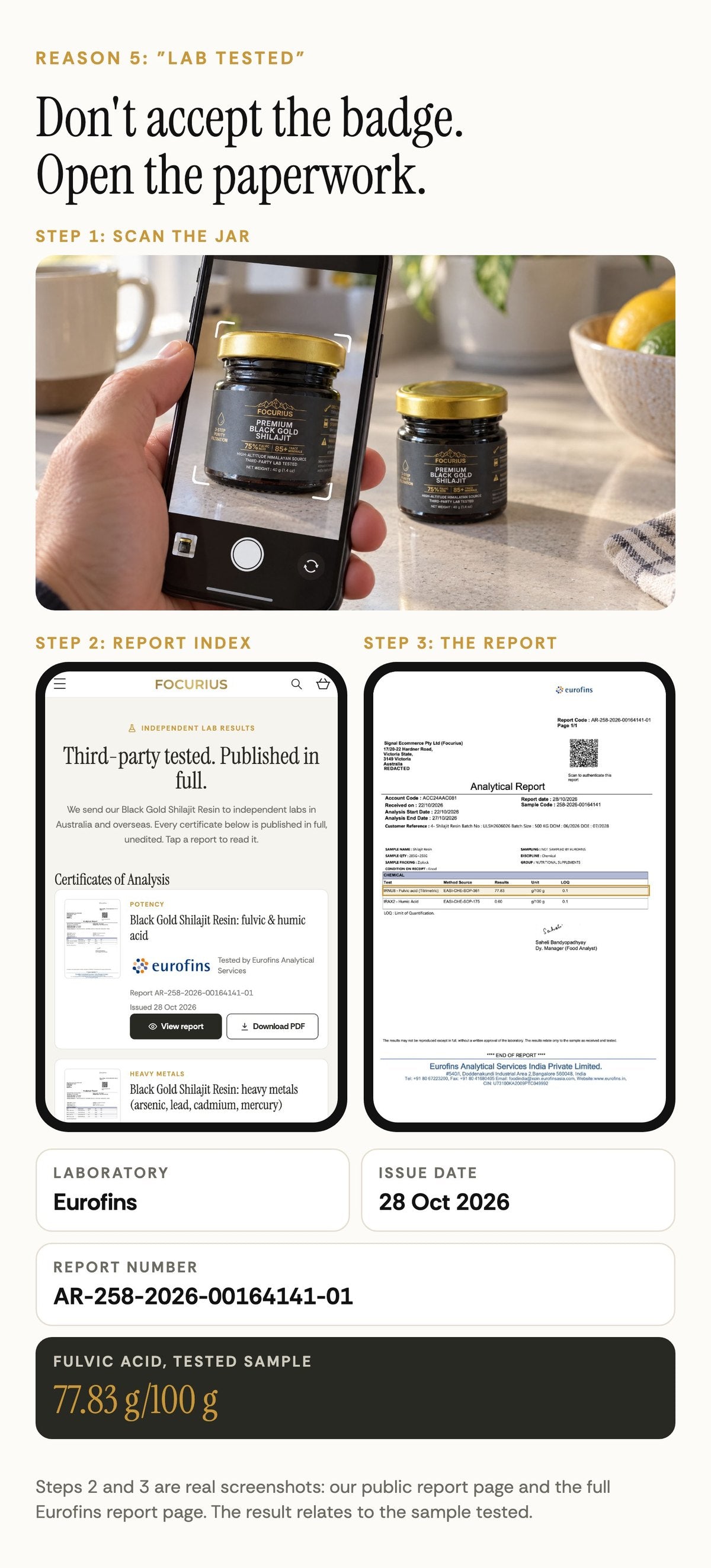
Our label states 75% fulvic acid. We then sent the finished sample to Eurofins, which measured 77.83 g per 100 g in report AR-258-2026-00164141-01. That result applies to the sample tested, not every jar forever. It does give you a real number to compare with our label.
“Himalayan” Is the Whole Origin Story
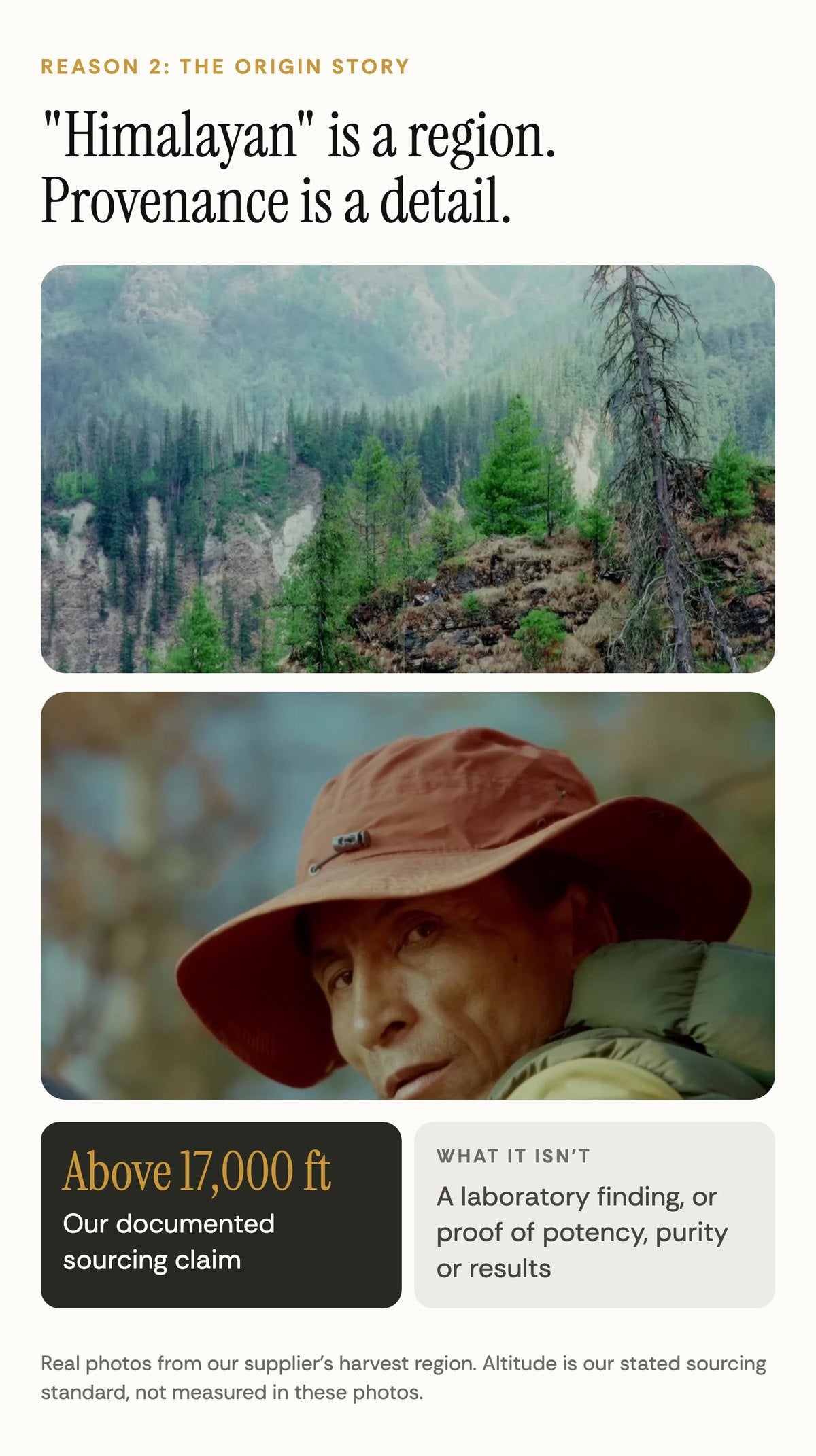
“From the Himalayas” covers a vast region. A mountain picture does not tell you the harvest area, altitude or chain of custody. Low-altitude material is not automatically fake, and altitude alone does not prove potency or purity. The warning sign is a grand origin story with no specific detail behind it.
We state that we source our raw shilajit from above 17,000 feet. That is our documented sourcing claim, not a laboratory finding and not a health guarantee. We disclose it because provenance should be specific enough for a buyer to question and for us to support with supplier records.
The Drying Method Is a Mystery
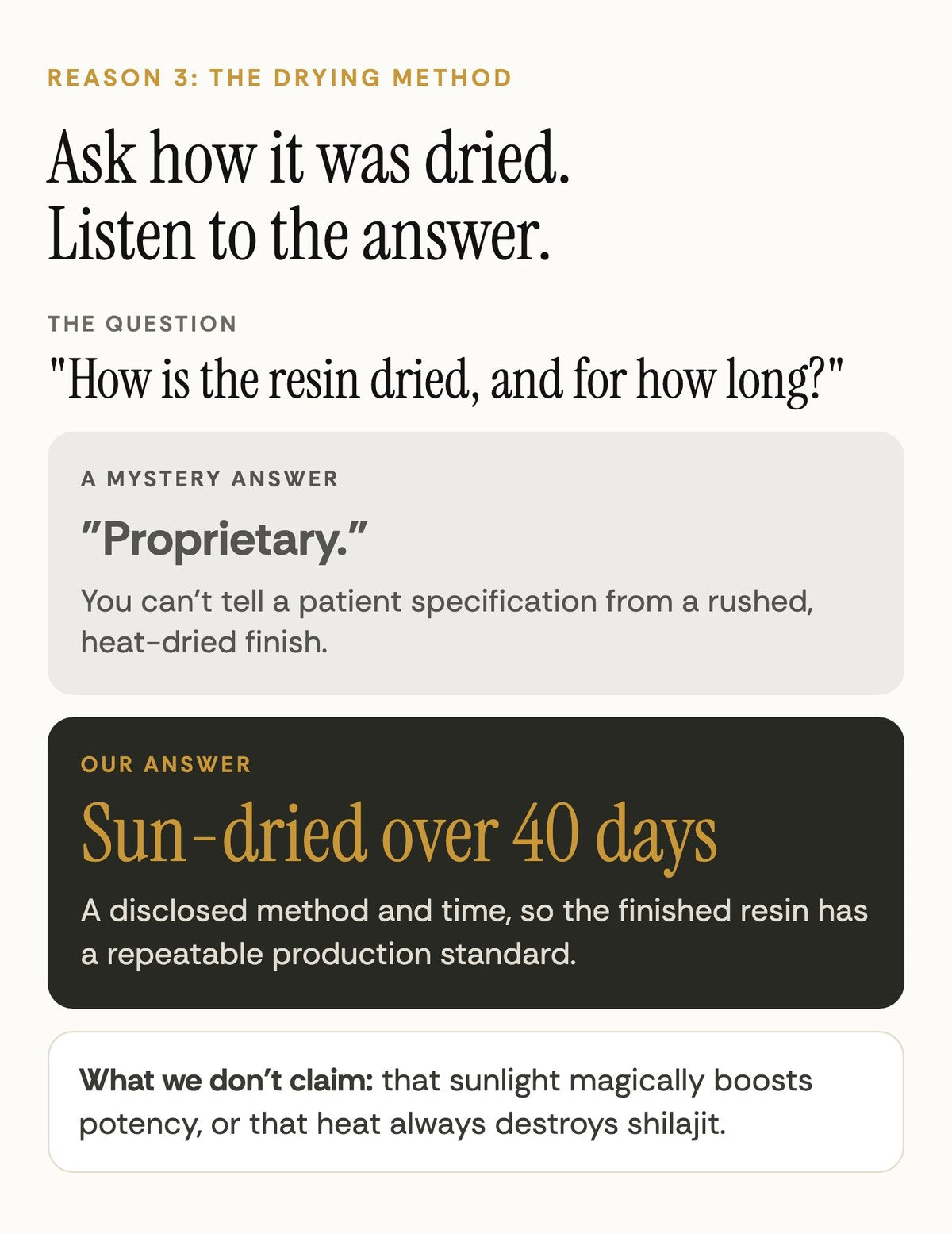
Raw material does not arrive as the finished resin in your mug. Moisture has to be managed, and a seller should be able to explain how. If the entire answer is “proprietary”, you cannot tell whether the maker used a patient specification or rushed the finish with heat.
We use a 40-day sun-drying process. We are not claiming that sunlight magically boosts potency or that heat always destroys shilajit. Our point is simpler: we disclose the method and the time because the finished resin should have a repeatable production standard, not an invisible shortcut.
“Filtered” Means One Unexplained Pass
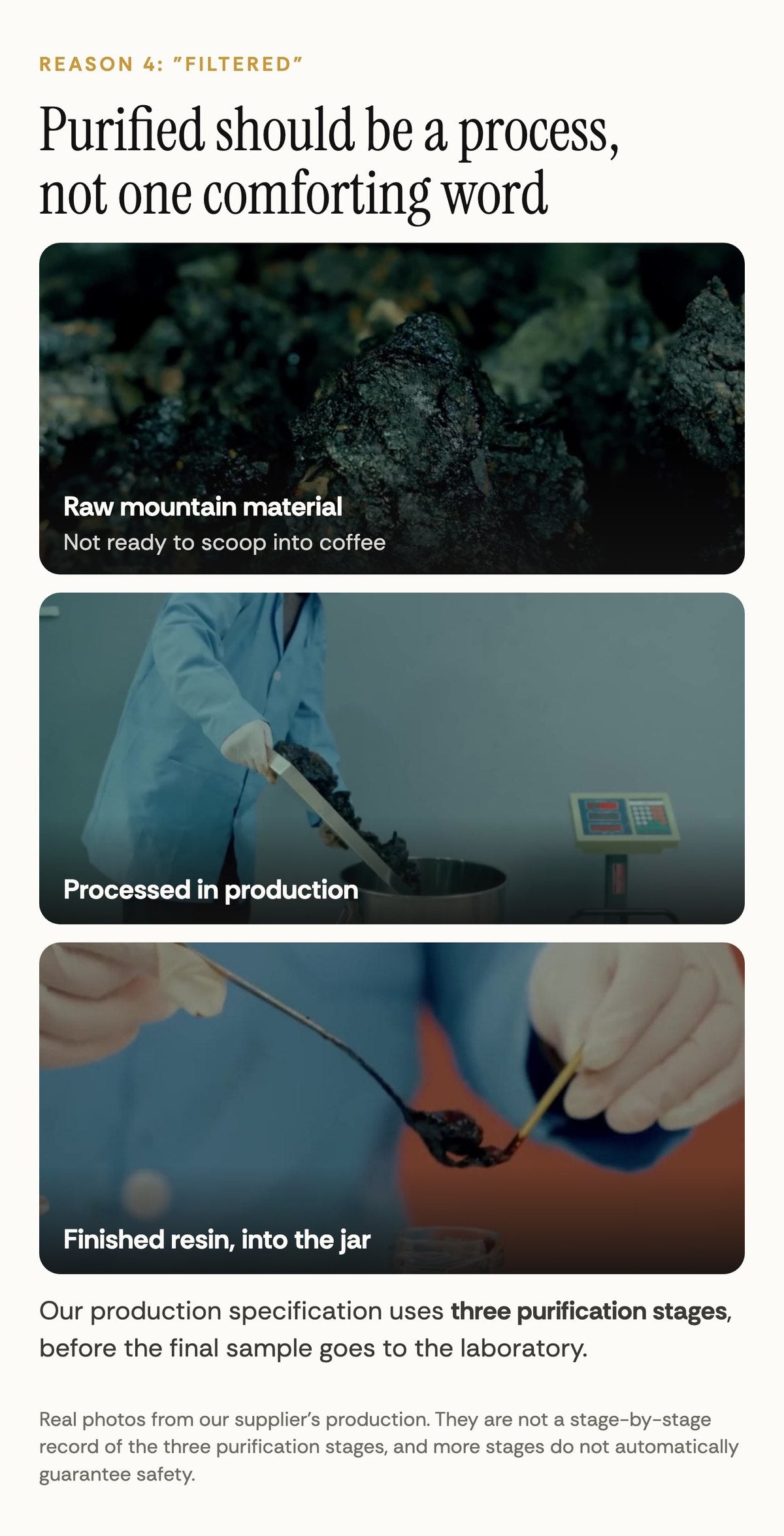
Raw mountain material is not ready to scoop straight into coffee. It needs a defined purification process. A one-stage claim may describe one useful step, but it leaves obvious questions: what happens in that stage, what is checked afterwards and is the finished material tested?
Our production specification uses three purification stages. More stages do not automatically guarantee safety. They show the process we have chosen before the final sample goes to the laboratory. For us, “purified” should mean a repeatable series of actions, not one comforting word on the front of a jar.
“Lab Tested” Has No Lab Report
This is the warning sign that matters most. A seller can print “third-party tested” in seconds. Ask to see the laboratory name, report number, issue date, sample details and actual results. If the document never appears, you are still being asked to trust the marketing.
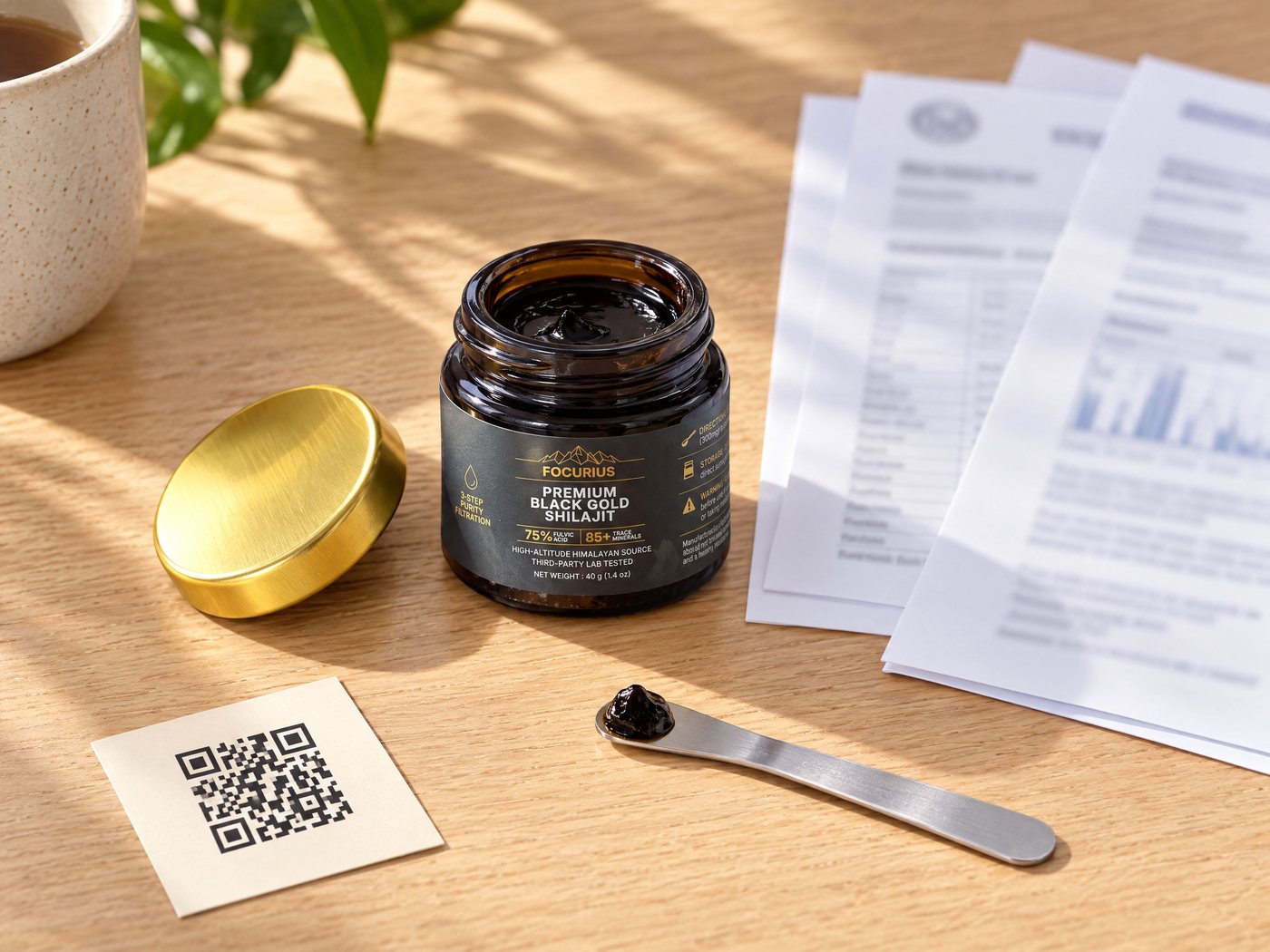
We publish eight reports through the QR code on our jar and at our public report page. The set covers fulvic and humic acid, minerals, moisture and testing for heavy metals, pesticides, mycotoxins and PAHs. The current heavy-metals report tests arsenic, cadmium, lead and mercury in the submitted sample. It does not prove every future batch is “heavy-metal free”. Public, sample-specific evidence is still far more useful than a badge with no paperwork.
Your 60-Second Authenticity Check
Before buying any shilajit, ask:
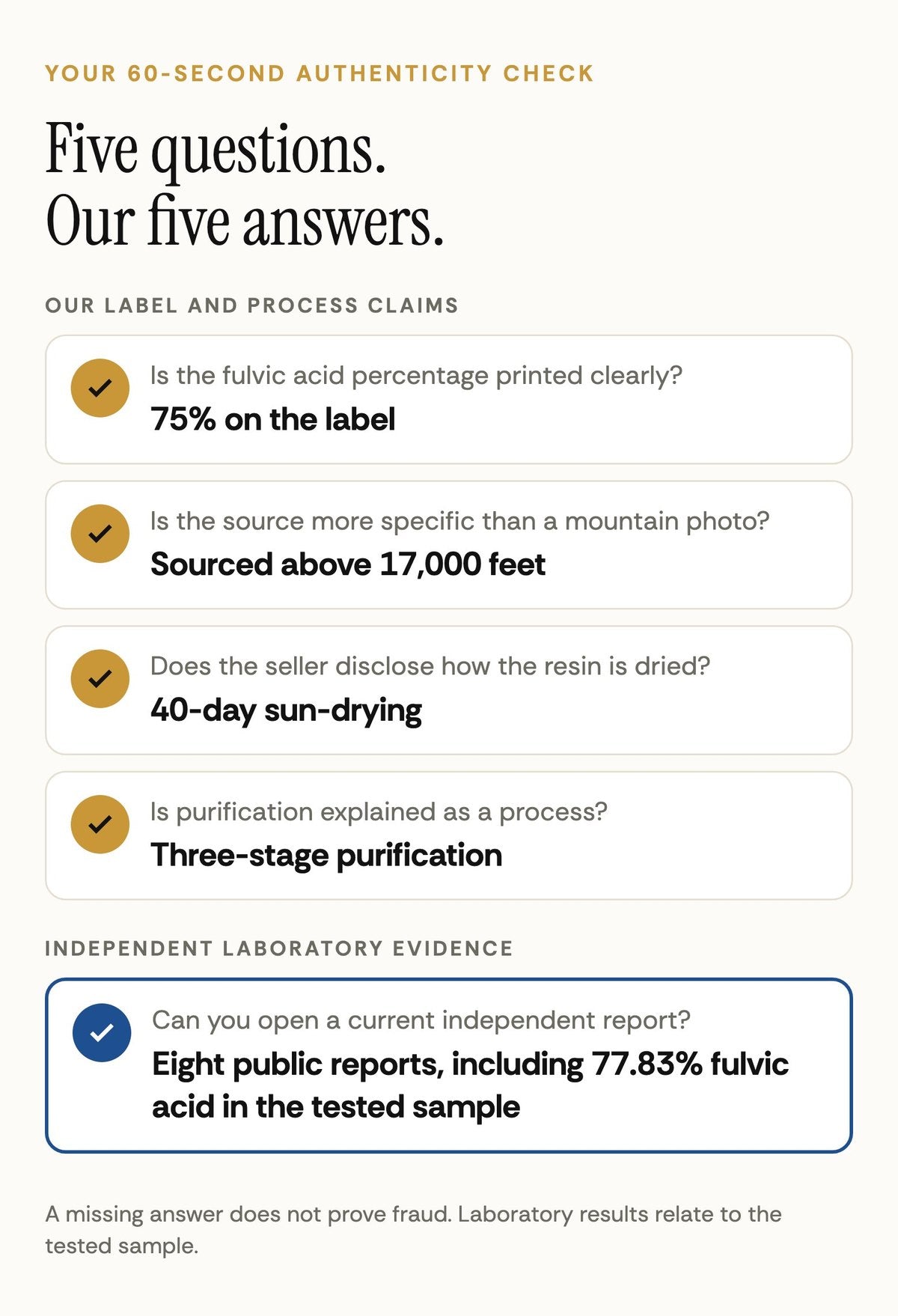
- Is the fulvic acid percentage printed clearly?
- Is the source more specific than a mountain photo?
- Does the seller disclose how the resin is dried?
- Is purification explained as a process, not an adjective?
- Can you open a current independent report without asking permission?
A missing answer does not prove fraud. Five missing answers mean you are buying a story and hoping there is good resin inside it.
Our answers are 75% on the label, 77.83% in the tested sample, sourcing above 17,000 feet, three-stage purification, 40-day sun-drying and eight public reports.
Choose the Jar That Shows Its Work
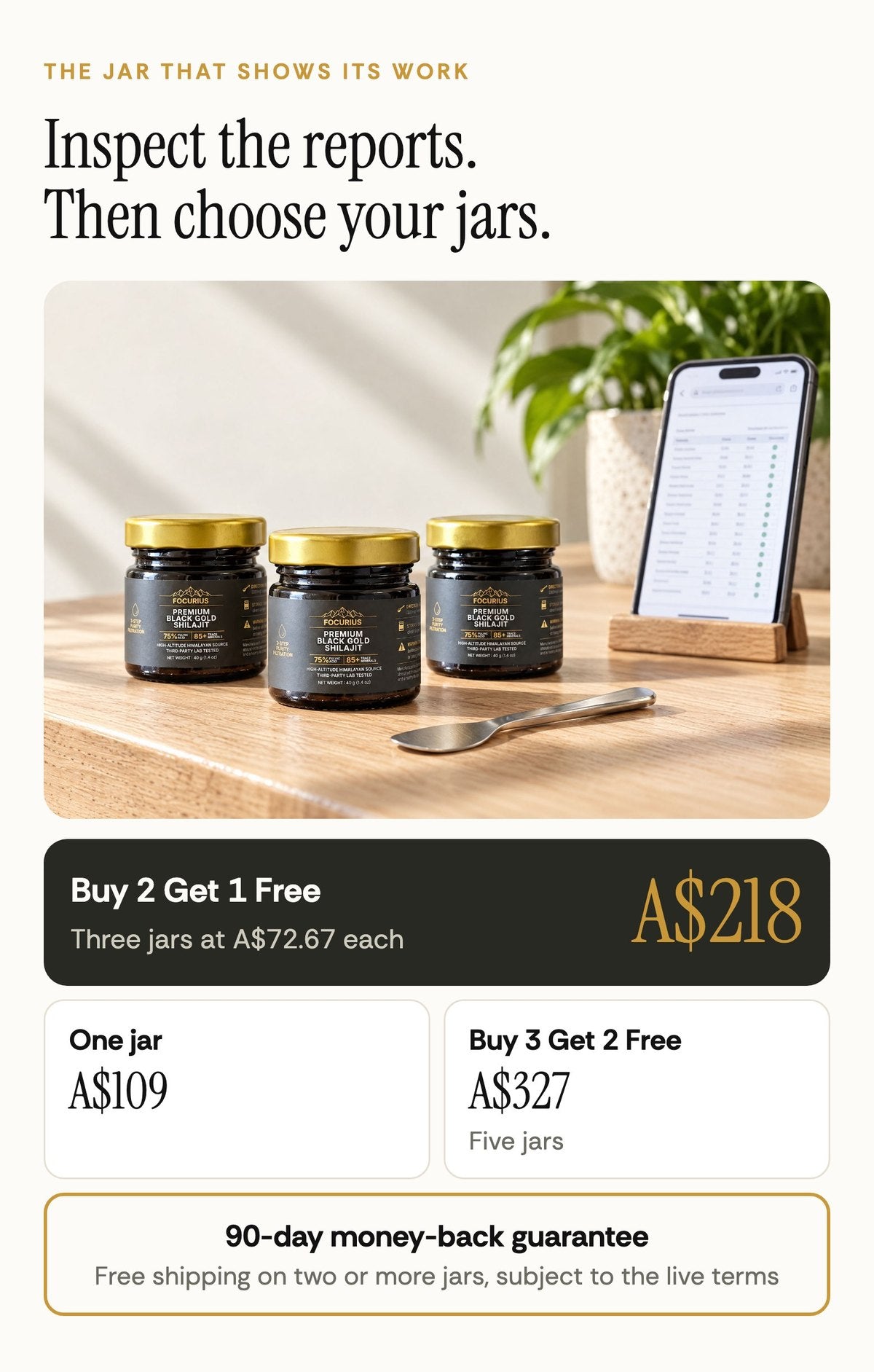
Our current lead offer is Buy 2 Get 1 Free for A$218. That is three jars at A$72.67 each. One jar is A$109, while the Buy 3 Get 2 Free bundle is A$327 for five jars. Current orders of two or more jars include free shipping, subject to the live terms.
Every order is backed by our 90-day money-back guarantee. Use the resin consistently, inspect the reports yourself and decide whether it earns a place in your morning.
FAQ
Does one warning sign prove shilajit is fake?
No. These are reasons to ask questions, not a counterfeit verdict. The strongest check is a current, relevant laboratory report read alongside a clear label and disclosed process.
How do I use resin?
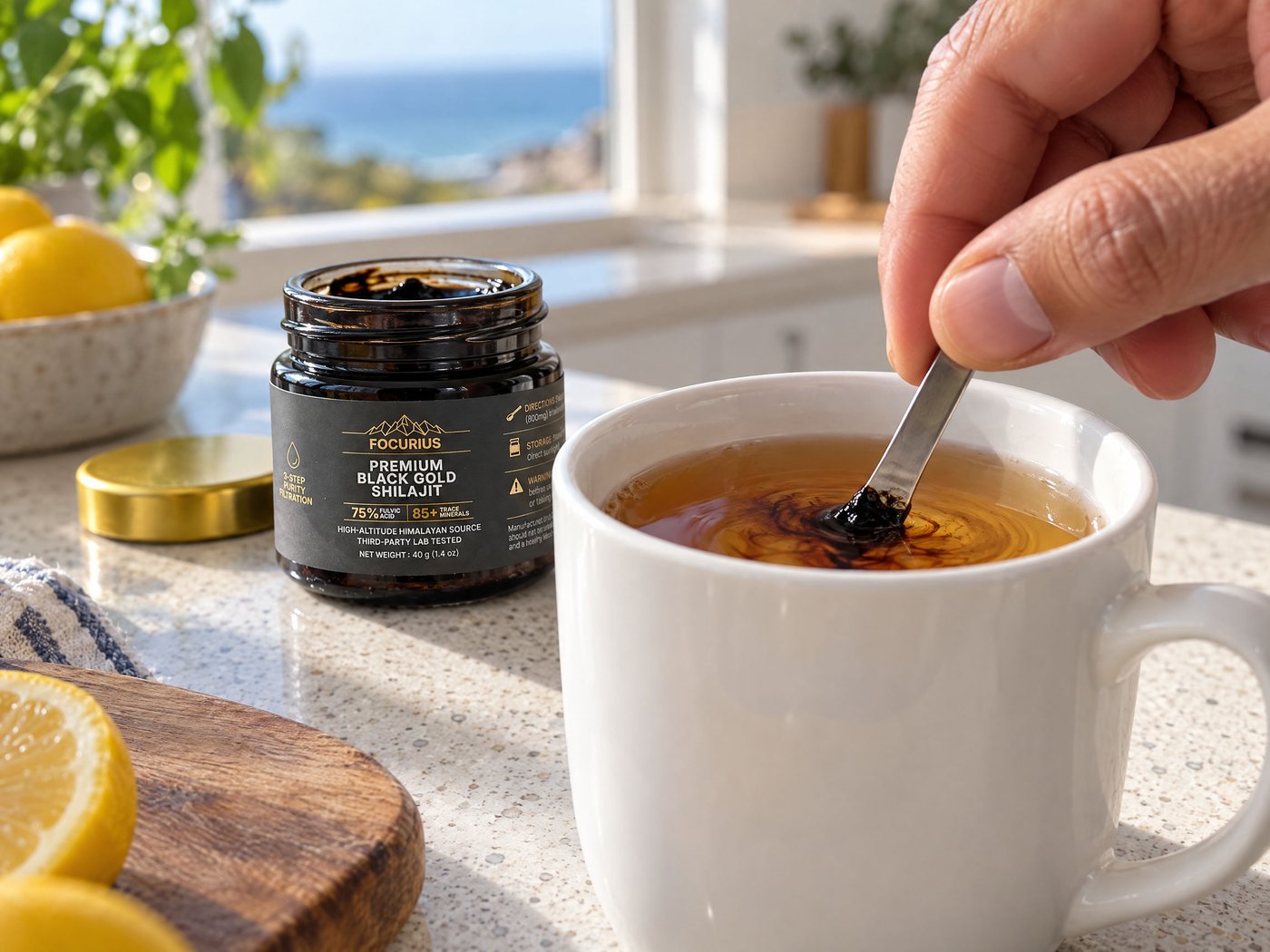
Follow the current label. Our usual direction is 300-500 mg, roughly a rice-grain to pea-sized amount, stirred into a warm drink, usually in the morning.
What should real resin taste like?
Expect an earthy, mineral and slightly bitter taste. Taste alone cannot prove composition or contaminant levels.
Can I take it with medication?
Speak with your healthcare professional before adding a supplement if you take medication, manage a health condition, are pregnant or are breastfeeding.
The jar is dark. The proof should be easy to see.
Always read the label and follow the directions for use. Consult your healthcare professional if you are pregnant, breastfeeding or taking medication.